
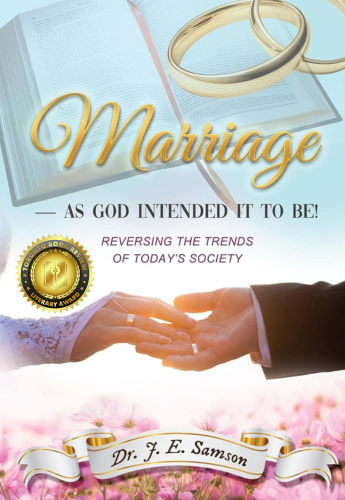
Books about marriage tend to fall into two camps. The first reassures you that love is enough, that feelings are a sufficient foundation, that the rest will sort itself out if your intentions are good. The second buries you in principles and frameworks until the subject feels more like a compliance exercise than a life decision. Dr. J. E. Samson manages to avoid both traps, and that is perhaps the most quietly impressive thing about Marriage: As God Intended It to Be.
Originally published in 2018 and reissued in 2022, the book reads as a structured companion for Christians at various stages of relationship, from the earliest questions of courtship through the deeper commitments that marriage requires. Samson begins at the beginning, tracing the origin of marriage not in culture or contract but in divine intention, and he does so with an assurance that never tips into arrogance. He is not arguing with the secular world. He is simply describing a different starting point, and then following that starting point wherever it leads.
That foundation matters because everything else in the book flows from it. If you accept the premise that marriage was designed with a purpose, then the practical chapters that follow carry real weight. Samson is specific where other writers prefer to stay vague, concrete where others retreat into metaphor. He asks directly how a believer should choose a partner, and he does not leave the answer floating in spiritual abstraction. He addresses what it means to trust God in the search for a companion, walks through a case study on the process of choosing well, and lays out the considerations that belong in that discernment with a clarity that feels both theologically grounded and genuinely useful.
The courtship chapter is among the most substantial in the book, and it earns that space. Samson maps different courtship scenarios, engages the question of duration with directness, and addresses the physical dimension of pre-marital relationships without flinching or moralizing unnecessarily. He is not trying to shame anyone. He is trying to give people a framework that holds. There is a real difference between those two things, and Samson understands it.
The structure throughout is admirably clear, each chapter closing with summary points and reflective challenges that make the book as useful in a small group or premarital counseling setting as it is in private reading. That dual utility is not accidental. Samson writes like someone who has worked with real people in real situations, who knows that good theology needs to be able to survive contact with ordinary life. The challenges at the end of each chapter are not decorative. They are invitations to do something with what you have just read.
There’s a quiet, honest sense of hope in Samson’s writing that feels real, not forced. He is not selling an ideal version of marriage as though the difficulties do not exist. He is describing a design that he genuinely believes is worth returning to, and asking the reader to take it seriously enough to build from it. The dedication to his late parents, from whom he says he learned the role of godly parents firsthand, signals from the first page that this is personal testimony as much as it is practical theology.
For a culture that has largely stopped expecting marriage to mean anything permanent or sacred, that is a quietly radical act. This is a book that believes something, and it makes that belief feel worth examining.
Purchase the Book Today on Amazon.
Rating: 4/5 Stars
Reviewer: Benjamin Ford
Date of Review: May 10, 2025


